November 18, 2026 - Practical Guides
Shoe Rack Buying Guide: Capacity, Design and Placement Tips (for Bangladesh Homes)
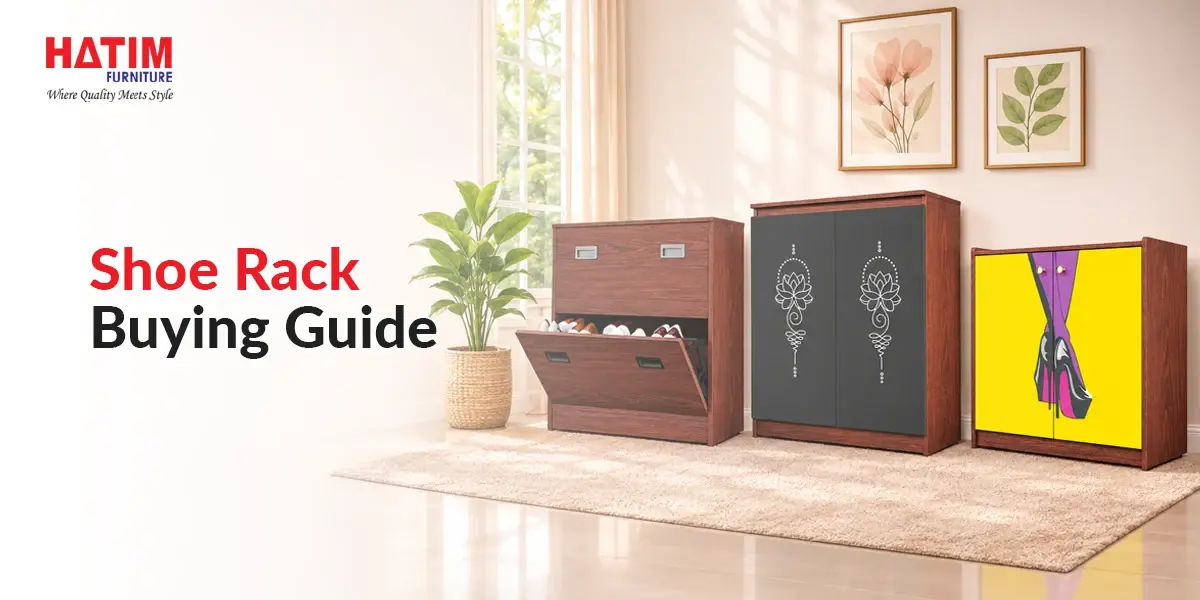
Choosing the best shoe rack depends on your available space, household size, and how well the material handles Bangladesh's humidity.
You first have to measure your entryway depth before you shop. Then, choose open shelving where airflow matters most, size the rack to your actual shoe count, and choose materials built for monsoon conditions.
A local price range of roughly BDT 2,600 to BDT 19,900 means there's a workable option at almost every budget. Here's what actually decides which one is right for your home.
1. Choose the Type
- Open racks: Best for airflow and quick access, though shoes stay on display.
- Closed cabinets: Hide clutter and dust, but need rear vents or slatted doors to avoid trapped humidity.
- Multi-tier or modular racks: Store the most pairs per square foot, ideal for compact Dhaka flats.
- Shoe benches: Add seating and coat hooks in one unit, useful for small entryways doing double duty.
2. Pick the Material
- Solid wood (Canadian Red Oak, teak): Longest lifespan, 12 to 20-plus years, naturally pest-resistant.
- Metal (powder-coated): Moisture-resistant and durable, 8 to 15 years, as long as the coating holds.
- Engineered wood/MDF: Budget-friendly, but the most vulnerable to swelling in humid rooms.
3. Match Size to Household
- 1 to 3 people: 15 to 25 pairs, a 3 to 5-tier rack around 60 to 80cm wide.
- 4 to 6 people: 30 to 50 pairs, a 6- to 8-tier modular rack or three-door cabinet.
- Joint families: 50-plus pairs, a tall cabinet or a few racks spread across the home.
- Add a 15 to 20 percent buffer to whatever number you count today.
Most households buy a shoe rack only after the pile by the door gets out of hand.
The trouble is that a rack that looks right in a showroom photo often fails within a year here, usually in one of three ways:
- Doors swelling shut after the first heavy monsoon
- Plastic connectors cracking under the weight of a few pairs of boots
- Shelves too shallow for anything larger than a sandal
The rest of this guide walks through exactly what to check before you buy, so the rack you bring home still works the way it should long after the rain stops.
Shoe Rack Types and Designs: Which Fits Your Home?
Walk into most furniture shops here, and you will find five broad categories of shoe racks, each solving a slightly different problem.
Some are built for speed, grabbing shoes on the way out the door. Some are built to be looked at.
A few exist purely to save floor space in a narrow flat. Knowing what each one does well, and where it falls short, makes the rest of this guide easier to use.
Open racks
Open racks are the most common and most affordable style sold in Bangladesh, usually built from powder-coated metal tubes joined with plastic connectors, or simple wooden slats stacked in tiers.
Hatim Furniture’s metal shoe rack (HSRHM-201) is the brand’s most budget-friendly option, priced at BDT 2,576.
Their real strength is airflow.
Shoes dry out faster, and odor has less chance to build up, which matters most through the monsoon months.
The tradeoff is visibility, since your whole shoe collection stays on display, which is why open racks tend to work best in entryways, balconies, or utility corridors rather than a formal living room.
Closed or cabinet racks with doors
Closed racks hide footwear behind swing or sliding doors, giving the entryway a cleaner, more finished look.
Hatim Furnitur's closed models lean into that, with sleek surfaces and shelved drawers meant to keep leather shoes away from dust. The catch is ventilation.
A sealed cabinet traps humidity, and monsoon season regularly pushes indoor relative humidity to 70 to 90 percent, which is enough to swell MDF panels, rust exposed metal fittings, and leave a musty smell inside a cabinet that never gets opened up.
If you are buying closed, ask specifically about rear vents or slatted door panels, and get into the habit of leaving the doors open for 15 to 30 minutes a day during the rainy season.
Multi-Tier and Modular Racks Save Floor Space
Multi-tier racks stack five, seven, or ten shelves vertically, which is the single most effective way to store more pairs without expanding the footprint.
That matters in a 600- 800 square foot Dhaka apartment, where floor space by the door is the scarcest thing in the house.
Modular versions let you add or remove tiers as the household's shoe collection grows.
The one thing worth watching is stability.
Taller, narrower units tip more easily, especially once boots are loaded onto the top shelves, so pairing a multi-tier rack with wall-anchor hardware is worth the extra ten minutes of setup.
Catwalk or decorative-panel racks
Catwalk racks use angled display shelves or laser-cut decorative side panels, sometimes finished with a printed vinyl wrap.
The idea is simple.
Shoe storage becomes something meant to be seen, not hidden. Hatim Furniture’s catwalk shoe rack is built from high-density melamine chipboard with decorative door panels, and it sits in the mid-range at around BDT 6,300 to BDT 7,100.
They make the most sense in larger entryways where the rack itself is part of the room's design, not something tucked out of sight.
Shoe benches and hall-tree combos
A shoe bench gives you somewhere to sit while putting your shoes on, not just somewhere to store them once they're off.
It pairs a cushioned or flat seat with cubbies or open shelving underneath.
A hall-tree combo adds overhead coat hooks, and sometimes a mirror, to build a full entryway station out of one piece of furniture.
In a compact flat, this single unit can stand in for a bench, a coat rack and a shoe rack at once.
Typical dimensions run 100 to 120cm wide, 40 to 50cm deep and 180 to 200cm tall, with room for 6 to 8 pairs plus four to six coat hooks.
Worth considering if you are renovating a small foyer and short on space for several separate pieces.
Open vs. Closed, at a glance
Both styles earn their place in a Bangladeshi home, just in different rooms. Here's how they stack up side by side.
| Feature | Open Rack | Closed Cabinet |
| Ventilation | Excellent, air moves freely around shoes | Poor unless fitted with rear vents or slatted doors |
| Access speed | Instant, grab and go | Slower, the door has to open first |
| Appearance | Utilitarian, shoes visible | Clean, concealed, more formal look |
| Best location | Entryway, balcony, ventilated corridor | Bedroom, enclosed foyer, drier rooms |
| Humidity risk | Low, natural airflow prevents trapped moisture | High, sealed doors trap monsoon-level humidity |
What Your Shoe Rack Is Made Of, and Why It Matters Here
Material choice decides how long a rack lasts, how it copes with Bangladesh's humidity, and how much upkeep it asks of you. Here's how the three most common options compare:
Solid Wood: Built to Last
Solid wood, such as the Canadian Red Oak used in Hatim Furniture's premium lines, offers the longest service life of any common material, often 12 to 20-plus years.
Hardwoods also carry a natural resistance to pests thanks to their density and natural oils.
That durability is part of why wooden pieces typically cost more than metal ones, along with the extra design work and sourcing involved.
Engineered Wood (MDF): Affordable, but Humidity-Sensitive
Engineered wood (MDF or chipboard finished with melamine laminate) costs less upfront, but it's the most vulnerable material to Bangladesh's climate.
Exposed edges swell permanently once they take on moisture, and shelves can start to sag under sustained loads of 15 or more pounds per tier.
Metal: Moisture-Resistant, but Only as Good as Its Joints
Metal racks, typically powder-coated steel tubing, resist moisture well as long as the coating stays intact.
They don't attract wood-boring pests and generally last 8 to 15 years, though they bring a different kind of failure point.
A complaint that comes up often in shoe rack reviews is the wobbly rack problem, and it almost always traces back to connector quality rather than the metal itself.
Cheaper racks rely on thin metal tubes joined with low-grade ABS plastic connectors.
These crack under repeated load, lose grip as dust builds up in the joints, or never fully seat during assembly.
The fix is simple: tap joints firmly into place with a rubber mallet during setup, keep connector surfaces clean, and add diagonal bracing if a tall unit still shifts once loaded.
A Note on Termites
Termite resistance deserves its own mention for wood buyers here, since almost no shoe rack guide addresses it directly.
Subterranean termites are active in Bangladesh's tropical climate, and untreated wood placed on a ground-floor flat or near a damp wall is the highest-risk scenario.
Look for anti-termite-treated wood, kiln-dried lumber, or naturally resistant species like teak or neem, and keep any wooden rack away from a wall showing damp patches or peeling paint.
Material comparison
A side-by-side look at how each option holds up on paper, so you can weigh cost against how long it'll actually last in your home.
| Material | Durability | Moisture Resistance | Maintenance | Typical BDT Price Band |
| Solid wood (oak, teak) | 12 to 20-plus years | Good, if sealed or varnished | Polish or wax every 3 to 6 months | 7,000 to 19,900 |
| Engineered wood (MDF/melamine) | 3 to 7 years | Poor, swells if wet | Wipe dry, keep away from water | 2,500 to 12,200 |
| Metal (powder-coated) | 8 to 15 years | Excellent while coating is intact | Wipe dust, check for rust spots | 2,500 to 7,000 |
| Plastic | 2 to 5 years | Excellent | Wipe clean, low upkeep | 500 to 1,500 |
What Size Rack Does Your Family Really Need?
Marketing figures for shoe rack capacity, the "holds 20 pairs" kind, almost always assume slim shoes: sandals, flats, or smaller sizes.
If your household wears UK 9 or above, or owns boots, real usable capacity typically drops 30 to 40 percent below the advertised number, simply because larger shoes take up more shelf depth and width than the manufacturer's test pairs.
Audit your shoes before you measure anything
Before comparing rack sizes, count what you actually own.
Sort current shoes into everyday pairs, boots or larger footwear, sandals and flats, and kids' shoes if there are any in the house.
Once you have a total, add a 15 to 20 percent buffer for new purchases, guests, and seasonal rotation.
A household with 25 pairs today is really shopping for something closer to 30 to 35 pairs of capacity. It is a small step, but it is the number the household-size guidance below depends on.
Small households and compact apartments (1 to 3 people)
A household of this size typically needs storage for 15 to 25 pairs.
A 3 to 5-tier open rack, or a compact two-door cabinet around 60 to 80cm wide, covers most needs, and a shelf depth of 30 to 35cm is usually enough, as long as the household does not own many oversized shoes.
Medium households (4 to 6 people)
This range typically needs 30 to 50 pairs of capacity, which points toward a 6- to 8-tier modular rack or a three-door cabinet in the 90 to 120cm width range.
Shelf depth should move up to 35 to 40cm to comfortably fit larger sneakers and light boots alongside standard sizes.
The figure on the box likely assumes smaller shoes, so if two or more household members wear larger sizes, size up rather than buying the label.
Larger or joint families
Joint or extended families often need 50-plus pairs of storage, sometimes 80 or more.
A tall 10-tier cabinet, a wall-mounted multi-door unit, or a few racks placed strategically around the home tend to work better than forcing everything into one unit.
A shelf depth of 40 to 50cm earns its footprint here, since it is the only range that comfortably fits full-size boots without forcing them to sit at an angle.
Where Should You Place a Shoe Rack? (The Question Most Guides Skip)
Where the rack sits matters just as much as what it's made of.
A shoe rack tucked into an open entryway behaves very differently from one sealed into a corridor or bedroom, and the spot you choose decides how well it ventilates, how convenient it is day to day, and how many monsoon seasons it survives.
Entryway and foyer placement, the default choice, and why
The entryway is the default choice because it stops outdoor dirt and moisture from spreading further into the home, but Bangladeshi apartment entryways run narrow, so clearance matters.
Leave 30 to 36 inches (roughly 75 to 90cm) of walking space between the rack and the opposite wall or door swing.
A simple formula: hallway width minus 36 inches equals your maximum rack depth.
A 48-inch-wide hallway, for example, can only take a rack about 12 inches (30cm) deep before it starts to feel cramped.
Staircase landings and shared corridors in apartment buildings
Shared corridors and staircase landings are common shoe-storage spots in Dhaka's multi-unit buildings, but they need extra care.
A rack that juts too far into a shared passage can block emergency egress or annoy neighbors.
These spaces also tend to be under-ventilated compared with a private entryway, so an open rack, or a closed cabinet with rear vents, is the safer choice here than a fully sealed unit.
Ventilation and humidity: what monsoon season does to an unventilated rack
This is the section that separates a rack that lasts a decade from one that fails within two years in Bangladesh.
Monsoon months push relative humidity to 70 to 90 percent at temperatures of 22 to 30°C, conditions that come close to ideal for mold growth on damp shoes.
Inside a sealed, unventilated cabinet, that moisture has nowhere to go.
The consequences are specific. MDF and engineered wood panels swell permanently at the cut edges, and the exposed metal fittings start to rust.
Trapped moisture combines with bacteria on damp shoes, leaving a musty odor that lingers even after the shoes themselves have dried. However, the fix is not complicated.
- Keep shoes a few centimeters off the floor and away from exterior walls
- Open cabinet doors for 15 to 30 minutes daily during the rainy season
- Use rechargeable silica gel packs inside closed units
- Where possible, keep indoor humidity below 55 to 60 percent with a dehumidifier or air conditioning
Where not to place a shoe rack
Bathrooms and kitchens see extreme, constant humidity spikes, so both are worth avoiding.
Skip balconies that catch direct rain mist, and be cautious with concrete-floored utility rooms, since ground moisture wicks upward into anything sitting directly on the floor.
Any wall showing dark patches, peeling paint, or a musty smell is a sign of trapped dampness. Keep the rack at least 5 to 10cm away from that wall, in whatever room.
Storage Features Worth Considering
Beyond the basic shelf and frame, a few features decide how well a rack actually works day to day. Some are worth paying attention to before you buy.
- Adjustable shelves: Good for mixing boots and flats in the same unit.
- Fixed shelves: Simpler and usually sturdier.
- Cubbies: One per family member, which suits larger households well.
- Tilt-out compartments: Easier access and better air circulation.
- Extra drawer or flat top: A place for keys, shoe polish or an umbrella stand.
Depth matters just as much as layout, and it should match the shoes going in rather than a generic "average" size.
- Flats and flip-flops: 23 to 30cm of depth is enough.
- Sneakers and loafers: Need 30 to 40cm.
- Boots and larger shoes (UK 9 and above, EU 43 and above): Need 40 to 50cm.
Get the depth wrong, and it shows fast: doors that will not close, or shoes hanging off the edge of the shelf.
Stability and anti-tip safety
Tall racks, six tiers or more, can tip forward if overloaded or bumped, a real hazard in homes with young children or pets who might climb or lean on the unit.
The fix is wall-anchor hardware: an anti-tip kit that secures the top of the rack to the wall with L-brackets. Or the straps often included with the unit.
Installation takes a few minutes with wall plugs suited to your wall type- concrete, brick, or drywall- and it is worth doing even when the rack feels stable empty.
Weight capacity
Weight capacity is a more specific number than general durability, and it matters because a shelf built for sandals is not necessarily built for boots.
As a rough guide, metal shelves typically handle 20 to 30 lbs (roughly 9 to 14kg) per tier, wooden shelves handle 15 to 25 lbs (7 to 11kg), and MDF or melamine shelves handle only 10 to 15 lbs (4.5 to 7kg) before sagging becomes visible over time.
One practical habit follows from this: heavier boots and sneakers belong on the lower, sturdier tiers, with lighter sandals and flats higher up.
Durability and Budget: What Drives Shoe Rack Price in Bangladesh
Hatim Furniture's shoe rack range runs from BDT 2,576 to BDT 19,228, spanning single-tier open racks up to premium solid-wood and catwalk cabinet models, and pricing across other Bangladeshi retailers follows a similar spread by material.
| Material/Type | BDT Price Range | Expected Lifespan | Best For |
| Plastic | 500 to 1,500 | 2 to 4 years | Budget buyers, renters, temporary setups |
| Metal (open, multi-tier) | 3,000 to 7,000 | 8 to 12 years | Humid areas, everyday durability |
| Engineered wood/MDF | 2,500 to 7,000 | 3 to 7 years | Dry indoor spaces, tighter budgets |
| Solid wood (oak, teak) | 7,000 to 19,900 | 12 to 20-plus years | Long-term investment, premium look |
| Closed cabinet (multi-door) | 8,000 to 15,000-plus | 10 to 15 years | Formal entryways, dust protection |
Hatim Furniture offers EMI on qualifying purchases, spreading the cost into 3, 6, 9, or 12-month installment plans through partner banks, often with a minimum purchase threshold around BDT 5,000.
Hatim Furniture’s product pages include an Easy Pay online payment option. If you’d rather pay in monthly instalments, ask the Hatim team which bank cards, tenures and minimum order values currently qualify for EMI
A Simple Checklist Before You Buy
Everything in this guide comes down to a handful of checks worth running before you hand over any money. Keep this list open on your phone at the showroom.
- Count your shoes and add a 15 to 20 percent buffer for future growth
- Measure the exact floor space, including door swing and walking clearance
- Confirm ventilation if buying a closed cabinet, and ask specifically about rear vents or slatted doors
- Check for anti-tip or wall-anchor hardware if there are kids or pets at home
- Verify per-shelf weight capacity, especially for households that store boots or heavier sneakers
- Ask whether the wood is treated against termites, or whether the metal is fully powder-coated
- Check EMI or installment availability if spreading the cost fits the budget better
- Look at real customer photos rather than stock images to judge assembly quality and long-term wear
Maintenance Tips to Keep Your Shoe Rack Lasting Longer
A little upkeep extends a shoe rack's life regardless of material.
- Air out wet shoes: Dry them on a separate wire rack before putting them back in storage, since damp shoes are the main source of mold and odor inside a rack.
- Wipe shelves down periodically: A damp cloth clears dust and early mold spores, especially inside closed cabinets.
- Check hardware every few months: Tighten loose screws and replace any plastic connectors that have started to crack before the rack becomes unstable.
Final Thoughts
The right shoe rack for a Bangladeshi home is not necessarily the cheapest or the biggest.
It is the one matched to your climate, your space, and how your household actually uses its shoes.
Monsoon humidity makes ventilation a genuine requirement rather than a nice-to-have; tight apartment layouts make accurate measurements and clearance planning worth the extra ten minutes, and a local price range of roughly BDT 2,600 to BDT 19,900, offered by Bangladesh's leading furniture brands, means there is a real option at almost every budget, especially with EMI plans available through most furniture retailers.
Get the capacity count right, check the material against Bangladesh's humidity and termite conditions, skip the stability check at your own risk, and the rack you buy should carry your entryway well past its first monsoon season.
Things People Ask Before They Buy
How many pairs of shoes does a standard shoe rack hold?
Most standard racks hold 15 to 25 pairs, though the number drops if your household wears larger sizes or boots.
Should I choose an open or closed shoe rack?
Open racks suit humid, poorly ventilated spots, while closed cabinets work best in drier rooms with rear vents or slatted doors.
Where is the best place to put a shoe rack in a Bangladeshi home or apartment?
The entryway is the default choice, with 30 to 36 inches of walking clearance kept free on either side.
Does a closed shoe rack trap moisture during monsoon season?
Yes, unless it has rear vents or slatted doors, a sealed cabinet traps humidity and can swell MDF panels or rust metal fittings.
What is the difference between a shoe rack and a shoe cabinet?
A rack leaves shoes open on shelves for airflow, while a cabinet hides them behind doors for a cleaner look.
What material is best for a shoe rack in a humid climate?
Solid wood like Canadian Red Oak or powder-coated metal handle Bangladesh's humidity better than engineered wood or MDF.