November 18, 2026 - Bedroom
Semi-Double vs. Double Bed: Which Size Actually Fits Your Room?
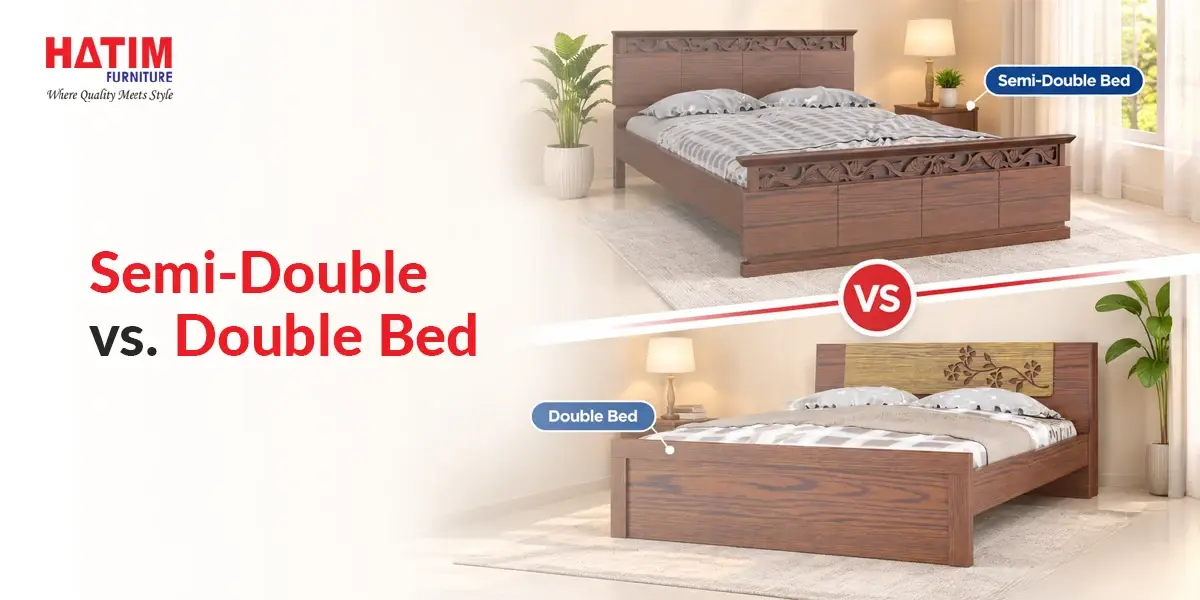
Semi-double vs double bed usually comes down to inches, not features. A semi-double runs about 120 cm (47 in) wide, the smaller of the two. A standard double, also called a full bed, is roomier at around 137 to 140 cm (54 in) wide. Which one works depends less on the mattress and more on the room around it.
Size and Space
- Semi-double: Width is about 120 cm x length 200 cm (48 x 78 in). Fits one person with extra room, or feels very tight for two adults.
- Double (Full): Width is about 137 to 140 cm x length 190 to 200 cm (54 to 78 in). Gives more room for one person, or handles two people who don't mind sleeping close.
Usage and Context
- Semi-double: Suits single adults in small bedrooms, students, and budget-conscious buyers. In Bangladesh, it's the default pick for compact flats and guest rooms.
- Double: Suits couples or a single sleeper who wants to stretch out or shares the bed with a pet. It's the standard choice for master bedrooms in standard-sized Dhaka apartments.
That's the answer in its simplest form.
But a width in centimetres doesn't tell you if the bed will actually fit your room. It won't tell you if it'll block your wardrobe door, or if you're about to pay for space you didn't need.
Get this decision wrong, and you're stuck squeezing past a bed frame every morning. Or paying to replace one that never should have come through the door in the first place.
Sometimes both, since a bed that doesn't fit often gets resold at a loss within the year. That's the real cost of guessing on size.
The rest of this guide removes the guesswork.
You'll find exact measurements in feet, inches, and centimetres, so nothing gets lost in conversion.
You'll see which size actually suits your room and the people sleeping in it. There's real Bangladeshi Taka pricing to work with, not vague ranges. And a checklist at the end to settle the decision before you order.
A Quick Note on Naming (Semi-Double Isn't the Same Everywhere)
Semi-double means different things depending on which country's chart you're reading. Japan lists it as a standardised 122 cm frame, common on hotel booking sites.
The UK calls the same footprint a small double.
The US skips the term and jumps to a Full bed at 137 cm (54 in). In Bangladesh, a double is usually a 5 ft (152 cm) bed, closer in width to a US queen
Local retailers, including Hatim Furniture, list semi-double at 48 inches (120 cm) wide.
That is the number worth trusting when shopping here, regardless of what an international size chart says.
You'll also see semi-double written as small double or large single, and a double occasionally called a full bed in American listings.
What Is a Semi-Double Bed? (Size, Who It's For)
A semi-double bed lives in the gap between a single and a full double, wider than a plain single, not as roomy as a standard double. It suits Bangladeshi apartments where every square foot is already spoken for, but a single bed still feels too narrow for adult sleep.
Exact Dimensions in Feet and Inches
- Width: 48 inches (4 ft / 120 cm)
- Length: 78 to 82 inches (6 ft 6 in to 6 ft 10 in / roughly 195 to 205 cm)
Hatim Furniture's semi-double bed frames typically run 82L x 48D x 32H inches, the standard footprint for this size locally. Matching mattresses are generally sold at 120 x 195 cm.
Also called: small double, large single. If a listing uses either of those terms instead of semi-double, it's almost always describing the same 120 cm-wide bed.
Who a Semi-Double Bed Actually Suits
A semi-double works well for a single adult who finds a plain single too narrow but doesn't need a full double's footprint.
It suits teenagers and students in compact bedrooms, and it's a sensible pick for guest rooms with 100 to 120 sq ft of space.
Budget-conscious buyers tend to gravitate here too, since semi-double frames and mattresses typically run 12 to 20 percent less than their double equivalents.
It's also the natural choice for a room doing double duty, a study desk sharing space with the bed, where every extra square foot matters.
Can Two People Sleep on a Semi-Double Bed?
Technically, yes.
At 120 cm wide, two adults get about 60 cm each, short of the 68 to 70 cm sleep experts generally recommend per person for undisturbed rest.
It works fine for occasional use, a guest room during a family visit, for instance.
As a permanent arrangement for a couple, it tends to feel cramped over time. A double bed is the steadier long-term choice.
What Is a Double Bed? (Size, Who It's For)
A double bed is the standard couple's bed worldwide, Bangladesh included, and it remains the most commonly sold bed size across local showrooms.
Exact Dimensions in Feet and Inches
- Width: about 60 inches (5 ft / 152 cm) in Bangladesh. The international "full" double is narrower at 54 inches (137 cm)
- Length: 75 to 80 inches (6 ft 3 in to 6 ft 8 in / roughly 190 to 200 cm)
Hatim Furniture's double bed frames measure about 61 to 62 inches across the outside (for example, HBDH-108-4-10 is 82 x 61 x 32 inches), so check the mattress size on each listing.
Who a Double Bed Actually Suits
A double bed suits couples who want more personal space than a semi-double allows, without the jump to a queen and its higher price tag.
It also works well for a single sleeper who shares the bed with a pet, since the extra 20 cm comfortably fits a medium dog or cat at the foot or side without crowding anyone.
Master bedrooms with 120 sq ft or more tend to handle a double with ease.
And for buyers thinking a few years ahead, double beds hold their resale value better in Bangladesh's active rental market, simply because more people search for that exact size.
Semi-Double vs. Double Bed: Side-by-Side Size Comparison
Shoppers weighing semi-double against double often glance sideways at single and queen too, so here's the fuller picture.
| Bed Size | Width (cm) | Width (in / ft) | Length (cm) | Length (in / ft) | Best For |
| Single / Twin | 90-97 cm | 36-38 in (3 ft) | 188-195 cm | 74-77 in (6 ft 2 in-6 ft 5 in) | Kids, students, very small rooms |
| Semi-Double | 120-122 cm | 48 in (4 ft) | 195-205 cm | 77-81 in (6 ft 5 in-6 ft 9 in) | Single adults, compact couples, guest rooms |
| Double / Full | 137-140 cm | 54-55 in (4 ft 6 in-5 ft) | 190-200 cm | 75-79 in (6 ft 3 in-6 ft 7 in) | Couples, single sleeper plus pet, standard bedrooms |
| Queen | 152 cm | 60 in (5 ft) | 203 cm | 80 in (6 ft 8 in) | Larger couples, master bedrooms |
Which Bed Fits Your Room Size?
A bed's dimensions alone don't tell you much. What matters is how it behaves inside your four walls, beside your wardrobe, and along the path you walk to the door each morning.
Bedrooms Under 100 sq ft (Small Flats, Single Rooms)
A semi-double or large single is almost always the better fit here.
Aim for at least 7.5 x 8 ft (2.3 x 2.4 m) of clear floor area to place a semi-double comfortably.
Squeeze a full double into a room this size, and you're often left with only 18 to 20 inches of walking space per side, workable, but tight if the room also needs a wardrobe or study table.
Bedrooms 100-150 sq ft (Standard Dhaka Apartment Bedrooms)
This is the sweet spot for a double bed.
A comfortable minimum sits around 9 x 10 ft (2.7 x 3 m), and 10 x 12 ft (3 x 3.6 m) gives genuinely easy circulation.
Go with a semi-double in a room this size instead, and you'll have generous 30-inch-plus walkways left over, useful if the room also functions as a home office.
Shared or Multi-Purpose Bedrooms (Study, Storage, Guest Room)
When a bedroom multitasks- sleeping, studying, storing suitcases- a semi-double pushed against one wall is usually the smarter layout.
It saves roughly 24 inches of floor space compared to a centred bed, and under-bed storage drawers make up for the smaller footprint.
How Much Walking Space Is Left? (Room + Bed + Clearance)
This is the part most bed-size guides skip.
They'll tell you a bed is 140 cm wide, but not what that means once it's actually in your room. Designers generally recommend at least 24 inches (60 cm) of walking space as a bare minimum, with 30 inches (76 cm) considered comfortable near a wardrobe door.
| Room Size | Bed Size | Clearance Each Side (Centred) | Verdict |
| 10 x 10 ft (100 sq ft) | Semi-double (4 ft wide) | ~36 in (3 ft) | Comfortable |
| 10 x 10 ft (100 sq ft) | Double (5 ft wide) | ~30 in (2.5 ft) | Tight but workable |
| 12 x 12 ft (144 sq ft) | Double (5 ft wide) | ~42 in (3.5 ft) | Spacious |
| 8 x 10 ft (80 sq ft) | Semi-double (4 ft wide) | ~24 in (2 ft) on one accessible side | Minimum acceptable |
Joint Families & Shared Rooms in Dhaka Homes
Multi-generational living is common across Dhaka households, and a single bedroom often carries more than one job: sleeping, storage, sometimes a prayer corner too.
A semi-double's smaller footprint earns its keep here.
Freeing up 20 to 30 sq ft can be the difference between fitting a wardrobe and study table in the same room, or not.
In older Dhaka buildings without lift access, a semi-double frame is also considerably easier for movers to carry up a narrow stairwell.
Semi-Double vs. Double: Comfort and Who Sleeps There
Comfort, in the end, comes down to space per sleeper.
A semi-double's 120 cm width gives about 60 cm per person when shared by two adults, below the 68 to 70 cm generally recommended for undisturbed sleep.
A 5 ft (152 cm) double gives each of two adults about 76 cm, comfortably above that threshold.
For pet owners, the extra width on a double comfortably fits a medium dog at the foot without crowding the person, and it tends to improve airflow for anyone who sleeps warm.
Price Comparison: Semi-Double vs. Double Bed in Bangladesh
Price is often what settles the decision once size and comfort are sorted, and Bangladeshi retailers offer a genuine spread depending on material.
| Bed Type | Material | Price Range (BDT) | Example Models |
| Semi-Double | Engineered wood / MFC board | Tk 12,500 - Tk 34,000 | HBSDH-108-4-10 (Tk 13,708), HBSDH-329 in mahogany (Tk 22,400) |
| Double | Engineered wood / solid wood | Tk 11,500 - Tk 51,500 | HBDH-108-4-10 (Tk 16,652), HBDH-306 (Tk 36,524) |
| Metal Double | Mild steel | Tk 12,100 - Tk 27,700 | HBDHM-208 (Tk 12,100), duplex-style HBDHMD-201 (Tk 25,500) |
HATIM's Dreamsoft and Bodycare mattresses currently list at Tk 9,120 to Tk 10,752 for a semi-double and Tk 11,328 to Tk 14,112 for a double.
Across the wider market, entry-level wooden frames start near Tk 7,000, while premium solid-teak king-size frames go past Tk 1,50,000, which places both semi-double and double firmly in the mid-range.
A few buying factors matter beyond the sticker price.
Most retailers, including Hatim Furniture, offer EMI facilities above a certain purchase threshold.
A one-year manufacturing warranty is standard on wooden frames. Delivery and installation are usually included but worth confirming upfront, since assembly typically needs two to three people on hand.
Renting vs. Buying: Resale and Rental Market Considerations
Bangladesh's furniture market carries an active resale and rental layer, especially in Dhaka, where tenants move often.
Double beds tend to hold their resale value better simply because more buyers search for that size.
If you're renting short-term, it's worth weighing that resale gap alongside how easily the frame disassembles for the next move.
What About Mattresses? Semi-Double vs. Double Mattress Sizing
Mattress sizing follows the bed frame closely, but it's worth double-checking before ordering, so you don't end up with an overhang or gaps at the edges.
- Semi-double mattress: 120 x 195 cm (48 x 77 in)
- Double mattress: 140 x 195 cm (55 x 77 in)
Most Bangladeshi mattresses run 6 to 8 inches thick for standard foam, with orthopaedic and pocket-spring variants reaching up to 10 inches.
A semi-double frame won't properly support a double mattress, so confirm frame dimensions before ordering the two separately; otherwise, you're looking at uncomfortable overhang and uneven edge wear.
Buying Locally: What to Check Before You Purchase
The size question settles the layout.
What settles the purchase itself is a shorter list of practical checks, the kind a showroom visit answers in minutes but an online listing rarely spells out.
- Material type: Solid wood, mahogany or teak, is the most durable and holds value best; engineered wood (MFC, MDF) is more budget-friendly and still sturdy; metal frames resist humidity best but lean utilitarian in look
- Warranty terms: Look for at least a one-year manufacturing defect warranty, standard among established retailers like Hatim Furniture
- In-showroom testing: Lying down on both semi-double and double frames in person is genuinely useful, since comfort shifts with headboard angle and slat spacing in ways a spec sheet never captures
- Delivery and installation: Confirm whether assembly is included, since most wooden frames need two to three people to set up properly
- EMI or installment options: Worth asking about upfront if you're weighing a double bed's higher price against a tighter monthly budget
How to Decide: A Simple Checklist
No showroom conversation replaces a tape measure at home. Run through these seven checks before you order, and the size question answers itself.
- Measure your room, wall to wall, length and width
- Subtract the bed's width plus roughly 48 inches (24 inches per side) to see what clearance remains
- Count regular sleepers and pets: one adult alone favours a semi-double; a couple, or a single sleeper with a pet, favours double
- Weigh rental versus owned property: a semi-double is easier for movers in older Dhaka buildings without lift access
- Set your budget: semi-double frame-plus-mattress combos typically save Tk 2,000 to Tk 5,000 over an equivalent double
- Think about resale value: double beds generally hold their price better if you expect to sell or upgrade soon
- Check warranty and EMI terms before finalising, especially for solid wood frames
Final Verdict
If your bedroom is under 100 sq ft, you sleep alone, or the room needs to double as a study or storage space, a semi-double bed is the more practical choice.
It frees up real floor space without forcing you onto an uncomfortably narrow single.
If you're a couple, share your bed with a pet, or simply want more room to stretch out at night, a double bed is worth the extra floor space it asks for, and it tends to hold its value better if you plan to resell or move in the coming years.
For most standard 120 to 150 sq ft Dhaka apartment bedrooms, a double strikes the better balance of comfort, practicality, and long-term value.
If space is genuinely tight, though, a well-chosen semi-double will serve just as reliably without the squeeze. Browse the full bed collection to see both sizes side by side.
Either way, one of Bangladesh's leading furniture brands has both ready to measure against your own four walls before you decide.
Things People Ask Before They Buy
What is the exact size difference between a semi-double and a double bed?
A semi-double is about 120 cm (48 in) wide, a double is about 137 to 140 cm (54 to 55 in) wide, roughly a 20 cm gap.
Is a semi-double bed big enough for two people?
Technically yes, but each person gets only about 60 cm of width, tighter than the 68 to 70 cm generally recommended for comfortable adult sleep.
Is a queen-size bed the same as a double bed in Bangladesh?
No, queen is wider at about 152 cm versus a double's 137 to 140 cm, a noticeable step up in space.
What size mattress fits a semi-double bed frame?
A 120 x 195 cm (48 x 77 in) mattress matches a standard semi-double frame.
What is a good bedroom size for a double bed?
At least 9 x 10 ft (100 to 150 sq ft), with 10 x 12 ft giving genuinely comfortable circulation.
Is a semi-double bed cheaper than a double bed?
Generally, yes, semi-double frame-and-mattress combos typically run Tk 2,000 to Tk 5,000 less than an equivalent double.