November 18, 2026 - Living Room
L-Shape vs. Straight Sofa: Which Layout Actually Fits Your Living Room?
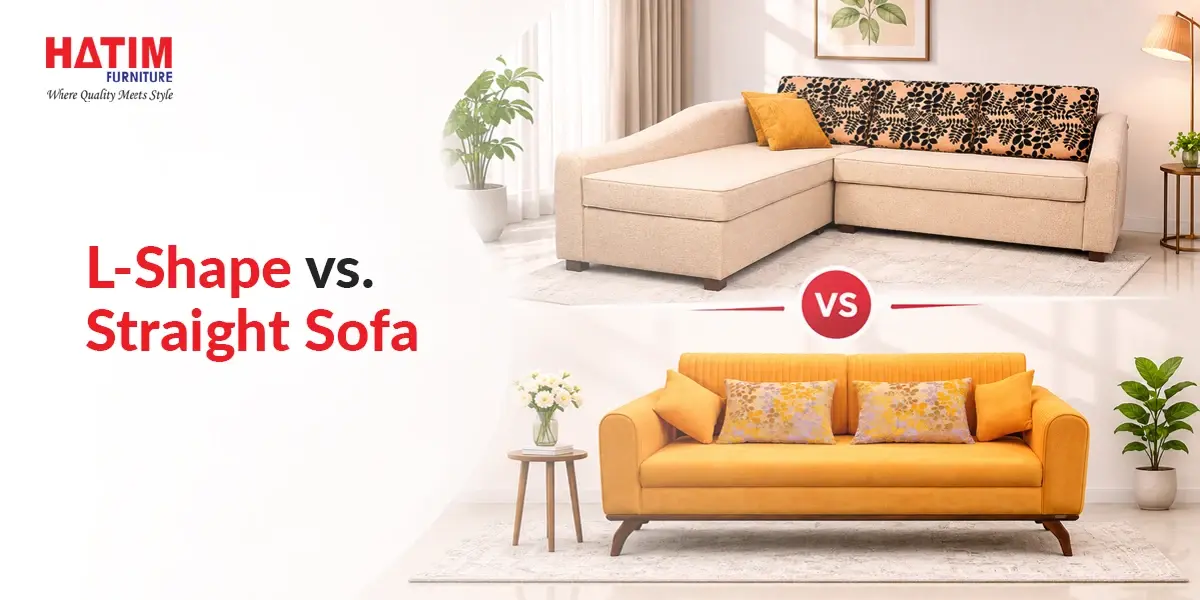
The choice between an L-shape vs straight sofa depends on your room size and how your household actually lives.
An L-shape sofa maximizes corner space and seats 5 to 6 or more people, ideal for family TV rooms. A straight 3-seater sofa (2 to 2.2m) offers easy flexibility and fits well in narrow or formal spaces.
Most people don't choose a sofa.
They inherit a shape someone else decided was right for them, a floor plan photo from a furniture app, a cousin's living room, a showroom display that looked good under showroom lighting.
Then they get it home, and the evenings start telling the truth. The chaise (the extended, lounger-style seat on an L-shaped sofa) blocks the balcony door.
The corner seat nobody sits in becomes the place where jackets go to be forgotten.
Five years pass rearranging the same three pieces of furniture around a couch that was never really built for the room.
The honest answer to L-shape vs straight sofa isn't about which one looks better in a photograph.
It's about how a family actually spends its evenings, how wide the stairwell is, whether someone naps there most afternoons, and whether the flat is a five-year home or a two-year stop.
Get those three things right, and the shape decides itself. As one of Bangladesh's leading furniture brands, Hatim Furniture builds both shapes for exactly these kinds of rooms."
Space and Layout
L-Shaped: Needs at least a 3x2 meter corner footprint. It acts as a visual divider in open-plan areas, but has a fixed orientation that's hard to rearrange.
Straight: Requires about 2 meters of linear wall or floor space. It's simple to move, swap walls, or pair with accent chairs.
Comfort and Use
L-Shaped: Features a built-in chaise for stretching out during movie nights, though only one person can truly recline at a time.
Straight: Best for traditional face-to-face conversation layouts when paired with a secondary loveseat or single chairs.
Quick Answer: Which Sofa Layout Should You Pick?
Choose an L-shape sofa if your living room is over 130 sq ft, you want maximum seating for 5 to 6 or more people, and you're building a TV-focused lounge around a corner.
Choose a straight sofa if your space is under 130 sq ft, you need flexible placement, or you rent and might move soon.
For standard 130 to 200 sq ft Dhaka apartments, either works. L-shapes seat more; straight sofas keep walkways clearer.
What Exactly Is a Straight Sofa?
A straight sofa is the sofa most Bangladeshi households grew up with.
It's the shape that sat under a grandmother's crocheted cover, the one with a low center table in front of it and a TV cabinet across the room, waiting for guests who'd arrive without warning and still find a seat.
Also called a standard or linear sofa, it's a single seating piece that runs along one wall. One fixed shape, no chaise, no extra corner section.
It comes as a 2-seater (a loveseat), a 3-seater, or as part of a sofa set, usually a 3+1+1 arrangement pairing a three-seater with two standalone chairs.
There's no chaise, no sectional joinery, just a simple, predictable footprint that has quietly worked in Bangladeshi drawing rooms for decades.
Typical dimensions (2-seater, 3-seater, 3+1+1 sofa set)
The table below breaks down width, depth, and height across the four most common straight sofa configurations, so you can measure your wall before you fall in love with anything.
| Sofa Type | Width (Length) | Depth | Height | Seating | Best For |
| 2-seater (Loveseat) | 55–65 in | 33–38 in | 30–36 in | 2 | Studio flats, small apartments |
| 3-seater (Standard) | 78–90 in | 33–40 in | 30–36 in | 3 | Standard 3-bed Dhaka flats |
| 3+1+1 Sofa Set | 3-seater + two ~30 in chairs | 33–40 in | 30–36 in | 5 | Family gatherings, entertaining |
| Compact apartment sofa | 70–78 in | 30–36 in | 30–34 in | 2–3 | Space-constrained 2-bed flats |
At Hatim Furniture, wooden sofa sets built from mahogany or engineered wood like Gorjon and Red Oak range from BDT 33,000 to BDT 145,000.
Budget-friendly, Chesterfield-style 5-seater sets start around ৳33,000, while three-seaters with quality upholstery and imported foam sit comfortably mid-range.
A single sofa within a set, like the wooden single sofa (HSSC-358-1), is the kind of piece that gets added to a three-seater to build out a full 3+1+1 arrangement without committing to a corner unit.
That gives a real reference point.
A budget 3+1+1 straight set can cost roughly what a single mid-range L-shape does, while seating a similar number of people across separate pieces instead of one connected unit.
A classic 3-seater sofa usually runs about 80 to 90 inches wide, 35 to 38 inches deep, and 30 to 36 inches high.
For a full 3+1+1 set, add roughly 60 inches for the two single chairs plus 18 to 24 inches of clearance between pieces.
The total footprint stretches to around 12 to 14 feet when arranged in a line.
Where straight sofas work best in Bangladeshi flats
Straight sofas suit studio flats (300 to 500 sq ft total, roughly 100 to 150 sq ft living area) with a 2-seater or compact 3-seater.
They suit 2-bed flats (100 to 130 sq ft living rooms) with a standard 3-seater plus one or two accent chairs, narrow living rooms under 10 feet wide, common in older Dhaka buildings, and formal drawing rooms, where a 3+1+1 set creates structured seating.
They also suit rental properties, since a single-piece sofa moves through stairwells and lifts more easily than a multi-piece L-shape.
What Is an L-Shape Sofa and How Does It Work in a Room?
An L-shape sofa, also called a sectional or corner sofa, places two seating sections at a 90-degree angle.
One arm usually carries a chaise lounge for stretching out; the other functions as a standard 3-seater.
It's a shape built for the corner nobody knows what to do with, the dead space behind a door swing or beside a window that every other piece of furniture seems to reject.
It's become the default choice for TV-focused family rooms and open-plan living-dining spaces in newer Bangladeshi apartments.
Hatim Furniture's Wooden L-Shape Sofa (HLSS-304) is a useful real-world reference, priced at ৳63,848 and built from engineered wood with fabric upholstery, sitting at the accessible end of the L-shape price range.
For a larger household, the Wooden L-Shape Sofa (HLSS-301) runs ৳80,408, sized at 109L x 71D x 31H inches, built from solid mahogany and engineered wood with an environmentally friendly lacquer finish, high-density imported fabric, and quality foam.
It ships within 3 to 15 days and carries a one-year free service warranty against manufacturing faults.
Hatim Furniture also lists a Wooden L-Shape Sofa (HLSS-302) and a compact L-shape double sofa (HSDC-315) for smaller footprints, and a sofa cum divan (HSCB-312) for anyone who wants the L-shape logic with an extra layer of function.
Sectional vs. corner sofa: are they the same thing?
Largely yes, in everyday retail usage.
A sectional sofa is the umbrella term for any multi-piece sofa arranged as an L-shape, a U-shape, or a straight run with an attached chaise.
A corner sofa is a specific type of sectional built to fit a 90-degree room corner.
Every corner sofa is a sectional, but not every sectional is corner-specific.
In Bangladesh, brands including Hatim Furniture use "L-shape" and "corner sofa" almost interchangeably, and most models sold locally are fixed-configuration rather than truly modular.
Left-facing vs. right-facing chaise, explained simply
"Facing" describes which side the chaise extends toward when you sit on the main section looking into the room.
If the extended seat sits on your left, it's a left-facing chaise. If it's on your right, it's right-facing.
Getting this wrong can block a door, a window, or a walking path, and it's a small mistake that somehow feels much bigger once the delivery van has already left.
As a rough rule, if your room's corner and entry sit on the left, a right-facing chaise usually keeps the path clear, and vice versa.
Confirm orientation with the seller before ordering, since product photos can be misleading.
A quiet aside on modular sofas: Modular sofas are made of separate seats, chaises, and corner wedges that rearrange into an L-shape, U-shape, or straight run as needed.
They suit renters and people who redecorate often.
In Bangladesh, they're harder to find and usually cost more for the extra hardware. Most local brands stick to fixed-configuration sofas for now.
L-Shape vs. Straight Sofa: Side-by-Side Comparison
Laid flat, the two shapes barely compete with each other. Here's how they actually stack up, feature by feature.
| Feature | L-Shape Sofa | Straight Sofa |
| Layout | Fixed 90-degree corner configuration | Fixed linear layout |
| Footprint | ~90–120 in long side + 60–78 in chaise side | 78–90 in for a 3-seater |
| Seating capacity | 5–6+ people | 3 people (3-seater); 5 in a 3+1+1 set |
| Corner utilization | Excellent, fills the corner directly | Poor, corner often left empty |
| Layout flexibility | Low, fixed chaise orientation | High, can go against any wall or float |
| Traffic flow | Can block paths if orientation is wrong | Generally better, keeps walkways clear |
| TV-focused seating | Excellent, with reclining chaise | Good, but no built-in recline |
| Conversation seating | Moderate, corner seat can feel isolated | Excellent, easy face-to-face arrangement |
| Best room size | 130–200+ sq ft, open-plan spaces | Under 130 sq ft, narrow rooms |
| Moving/delivery | Harder, multi-piece, needs measuring | Easier, single piece, standard doorways |
| Price (Bangladesh) | ৳45,000–৳150,000 (Hatim Furniture) | ৳28,800–৳132,700 (Hatim Furniture) |
| Best for | Owners, large families, lounge use | Renters, small flats, formal entertaining |
Which Sofa Fits Your Room Size? (With Bangladeshi Apartment Benchmarks)
Square footage tells you what will physically fit, but it doesn't tell you what will feel right once the coffee table, the TV unit, and the walkway to the kitchen are all fighting for the same floor.
Here's how the two layouts actually play out across the room sizes most common in Dhaka.
Living rooms under 130 sq ft (studio and 2-bed flats)
Go with a straight sofa.
A standard 3-seater (78 to 90 inches) takes up roughly 25 to 30 sq ft, leaving room for a coffee table and clear walkways of 24 to 30 inches.
Full-size L-shapes need about 14x12 ft (168 sq ft), while a compact model like the HLSS-304 (86 x 60 inches) fits rooms from about 130 sq ft, too large for most studio or 2-bed living rooms in Dhaka, which typically run 100 to 130 sq ft.
A 2-seater loveseat suits the smaller end of that range. A compact 3-seater with one accent chair fits the upper end.
Living rooms 130–200 sq ft (standard 3-bed Dhaka apartments)
Both layouts work here. It comes down to priorities.
Choose an L-shape for more seating capacity, a TV-focused lounge feel, and full corner use, provided the room is at least 14x12 ft (168 sq ft) for a full-size model.
Choose a straight sofa or 3+1+1 set for flexible placement, formal conversation seating, or if your room has multiple doorways or is narrower than 12 feet.
Open-plan living-dining spaces in newer flats
Newer Dhaka apartments increasingly combine living and dining into one 250 to 400+ sq ft space, and this is where L-shapes earn their keep.
The sofa's back becomes a soft divider between zones without a wall, and the corner-hugging shape keeps the center open for a larger coffee table or a bit of play space.
A medium L-shape (90 to 102 inches long side) suits 250 to 300 sq ft layouts. A larger one (108 to 120 inches) fits 300 to 400+ sq ft spaces.
Position the chaise away from the dining zone so it doesn't block the path between the kitchen and living area.
Seating Capacity and Family Size: Which Layout Seats More?
A living room rarely runs out of space before it runs out of seats — the real question is how many people you're actually making room for.
| Sofa Type | Everyday Seating | Guest Capacity | Best Family Size |
| 2-seater straight | 2 | 2–3 (with 1 chair) | Couples, singles |
| 3-seater straight | 3 | 4–5 (with chairs) | Small families (3–4) |
| 3+1+1 sofa set | 5 | 6–7 | Medium families, entertaining |
| L-shape (medium) | 5–6 | 7–8 | Large families (5+) |
| L-shape (large) | 6–7+ | 8–10 | Extended/joint families |
L-shapes generally seat more people per square foot than an equivalent straight arrangement.
A medium L-shape can match a 3-seater plus two accent chairs in seating count while feeling like one cohesive lounge piece rather than three scattered ones.
The inner corner seat adds an extra spot, though some find it a little awkward for sustained conversation, a point worth sitting with for a moment (more on that below).
For everyday family use, L-shapes tend to win. For structured entertaining, a 3+1+1 straight set often feels more appropriate.
Which Layout Suits How You Actually Use the Living Room? (Conversation vs. TV-Focused Seating)
This is the question that actually matters, more than square footage or price.
It's really a question about what a living room is for in your house, and that answer looks different from one family to the next.
If your household leans toward conversation, hosting relatives, tea-time chats, formal guests, a straight sofa, especially a 3+1+1 set, works better because everyone can angle toward each other for eye contact.
Traditional Bangladeshi drawing-room seating still favors this arrangement for exactly that reason.
If your living room revolves around the TV, movie nights, cricket matches, weekend lounging, an L-shape is the stronger choice.
It creates a natural viewing angle toward the screen, and the chaise lets people recline or stretch out fully, something a straight sofa can't do without an added ottoman.
More than one person can lie down at once- kids on the chaise, adults on the long side, everyone still technically "sitting together."
A simple way to decide: daily TV watching and casual lounging point to an L-shape.
Formal entertaining or conversation-first seating points to a straight sofa. If your room mixes both uses and is 150+ sq ft, an L-shape still tends to flex better. Under 130 sq ft, a straight sofa is the safer choice.
Bangladesh Climate and Practical Considerations
Furniture here lives a harder life than the showroom lets on.
Between the humidity, the monsoon months, and the heat that never fully lets up, a sofa's real test starts long after it's been carried up the stairs.
Humidity, monsoon season, and fabric vs. leather upholstery
Bangladesh sees 70 to 85% humidity year-round, climbing further during the June to September monsoon, conditions that quietly invite mold, fabric moisture retention, and sticky leather.
Fabric upholstery, the standard offering across most sofa lines, is breathable and comfortable but absorbs humidity in poorly ventilated rooms.
High-GSM microfiber or solution-dyed polypropylene resist moisture better, while heavy velvet traps it and invites mildew.
Leather resists humidity well and wipes clean easily, but non-breathable finishes get sticky in heat, and bonded or synthetic leatherette can peel. Full-grain leather holds up best.
Basic monsoon care is mostly common sense once someone says it out loud. Keep sofas 1 to 1.5 meters from windows and exterior walls.
Run a dehumidifier for a few hours daily during monsoon. Avoid pushing sofas flush against walls. Stand loose cushions on edge periodically so the foam cores can breathe.
Termites, wood quality, and frame durability for L-shape vs. straight
Wood choice drives both price and durability.
Mahogany and Gorjon/Red Oak engineered wood span the sofa range at Hatim Furniture. Mahogany resists termites naturally.
It typically appears in mid-range to premium sofas, ৳63,000 to ৳110,500. Treated Gorjon anchors the budget tier, ৳33,000 to ৳63,000. Segun, or teak, is the most termite-resistant option where available. It commands premium pricing.
Structurally, L-shapes carry more complex joinery at the corner junction, so the frame needs reinforced brackets to avoid wobbling over years of use.
Straight sofas have simpler construction with fewer stress points, which generally makes them more stable long-term.
Either way, Hatim Furniture backs its sofas with a one-year free service warranty covering manufacturing faults, using environment-friendly lacquer finishes meant to extend frame life in humid conditions.
Delivery and moving through narrow stairwells or building lifts
Older Dhaka buildings often have narrow stairwells (36 to 42 inches), small lifts, and doorways as tight as 30 to 36 inches, a real constraint for a multi-piece L-shape.
Most L-shapes arrive in separate sections (long side, chaise, corner) and get assembled on-site, which helps with tight spaces but still means measuring each piece against your doorway and lift dimensions beforehand.
Straight sofas are typically single-piece, lighter, and easier to carry up a stairwell if there's no working lift.
Hatim Furniture addresses this with free nationwide delivery and installation, along with an assembly team experienced in tight stairwells and lifts.
Their recommended method is a simple one: mark the sofa's footprint on your floor with painter's tape before ordering, to confirm it fits both the room and the delivery path.
Price Comparison: L-Shape vs. Straight Sofa in Bangladesh
Hatim Furniture's sofa set pricing breaks into three bands.
| Segment | Price Range (BDT) | What You Get |
| Budget-friendly | 33,000–56,000 | Chesterfield or geometric 5-seater sets; Gorjon engineered wood, standard fabric |
| Mid-range | 63,000–110,500 | Mahogany wood, high-density foam, table/ottoman/side unit; most L-shapes fall here |
| Premium | 121,000–145,000 | Top-tier craftsmanship, premium fabrics, solid wood frames |
Three factors drive that price, according to Hatim Furniture's own breakdown.
- Material quality comes first. Mahogany, Gorjon, or Segun cost more than basic engineered wood. A full mahogany set can run up to ৳1,00,000.
- Craftsmanship and construction come second. Intricate or traditional designs cost more than minimalist styles. Hardwood frames add durability, and the price goes up along with it.
- Functionality comes third. L-shaped designs and features like built-in storage, recliner mechanisms, or sofa-beds increase both versatility and cost.
Cost per seat sharpens the comparison.
A budget 3-seater like the HSTC-319 (৳28,796) works out to about ৳9,600 per seat.
A mid-range L-shape like the HLSS-301 (৳80,408 for 5 to 6 seats) comes to roughly ৳13,400 to ৳16,080 per seat.
A premium 5-seater set from about ৳121,000 runs closer to ৳24,200 per seat. In the mid-range segment, L-shapes often deliver better value per seat than an equivalent straight sofa set.
On payment, Hatim Funriture offers EMI and installment options for online purchases, accepts mobile banking and card payments, and periodically runs storewide discounts.
Pros and Cons at a Glance
Every shape trades something for something else. Laid out plainly, side by side, it's easier to see which trade-off you can actually live with.
L-shaped sofa: benefits and drawbacks
The corner gets used, the family fits, and movie nights get a proper lounge. That convenience comes with a few fixed trade-offs worth knowing before delivery day.
Benefits:
- Seats more, uses less floor - Maximizes seating capacity in a compact footprint
- Claims dead space - Uses corner space that would otherwise sit empty
- Built for lounging - Suits TV-focused seating with a reclining chaise
- Divides without walls - Helps define a living zone in open-plan spaces
- Better value per seat - Often delivers more seating per taka in the mid-range tier
Drawbacks:
- The corner seat problem - A recurring complaint online: the inner seat feels "wasted," hard to reach, and slightly cut off from group conversation
- One shape, no flexibility - Fixed chaise orientation means it can't be rearranged once ordered
- Wrong orientation, real consequences - A left/right mix-up can block a door or walkway
- Trickier to move in - Multi-piece delivery through narrow stairwells or lifts takes more planning
- Needs the room to match - Needs at least 130 sq ft for a compact model, or 168 sq ft for a full-size one
- Higher entry price - Compact L-shapes start around ৳45,600, versus about ৳28,800 for a basic 3-seater
Straight sofa: benefits and drawbacks
Simple, familiar, and it goes wherever the room needs it. The honesty of a straight sofa is that what you see is what you get, seating included.
Benefits:
- Goes anywhere - Flexible placement against any wall or floated in the room
- Fits small spaces easily - Works comfortably in narrow or compact rooms
- Keeps paths open - Maintains clear traffic flow through the room
- Moves without hassle - Passes through doorways without disassembly
- Built for conversation - Supports face-to-face seating naturally
- Lower price to start - The most accessible entry point in the range
Drawbacks:
- Fewer seats per piece — Seats fewer people than an equivalent L-shape
- Corners go unused — Needs extra chairs to make use of room corners
- No built-in recline — Lacks the lounge-style stretch of a chaise
- Less suited to TV-first living — Works better for conversation than casual lounging
How to Decide: A Simple Checklist
No spreadsheet needed. Most of this comes down to five honest answers about your room, your budget, and how you actually spend your evenings.
- Room size: 130+ sq ft favors an L-shape; under 130 sq ft favors a straight sofa. Narrow rooms (under 10 ft wide) favor a straight sofa
- Layout type: Open-plan living-dining spaces favor an L-shape for zone definition
- Seating needs: 5+ regular seats point to an L-shape or a 3+1+1 set; 3 to 4 seats are fine with a standard 3-seater
- Budget: Under ৳50,000 gets you a straight 3-seater or a compact L-shape (from about ৳45,600); ৳63,000 to ৳110,500 opens up mid-range L-shapes or premium straight sets; ৳121,000+ unlocks premium options in either category
- Daily use: TV-and-lounging households lean L-shape; conversation-and-entertaining households lean straight sofa
Are you renting or do you own the flat?
This single factor often decides the debate more than anything on a spec sheet.
If you're renting and likely to move within a year or two, a straight sofa is the lower-friction choice, easier to carry through narrow stairwells, fitting more flats without custom measuring, and representing a smaller sunk cost if it doesn't suit the next place.
If you own your flat and are furnishing for the long term, an L-shape's higher upfront cost is easier to justify.
It maximizes seating and corner use for years, and a one-year manufacturing warranty reduces the risk of an expensive mistake.
A middle path for renters planning to buy soon: start with a budget straight sofa (৳33,000 to ৳56,000) and upgrade to an L-shape once you're settled somewhere permanent.
Common Mistakes to Avoid When Choosing Between L-Shape and Straight Sofas
Most sofa regrets aren't about the sofa. They're about a measurement someone skipped or a detail someone assumed would work itself out.
- Skipping measurements - Check doorway, lift, and stairwell dimensions before ordering, and tape out the footprint on your floor
- Ignoring traffic flow - Leave at least 24 to 30 inches of walkway clearance, especially around an L-shape's chaise
- Buying an L-shape for a room under 130 sq ft - It will overwhelm the space; a straight sofa fits better
- Choosing the wrong chaise orientation - A mismatched left or right-facing chaise can block a door, window, or TV sightline
- Prioritizing looks over daily use - Decide based on whether you mostly watch TV, lounge, or entertain, not just which shape photographs better
- Overlooking wood quality - Untreated or low-grade wood frames are vulnerable to termites and warping in Bangladesh's humidity; mahogany, Gorjon, or Red Oak from an established brand hold up better
- Picking the wrong fabric for the climate - Velvet and low-grade synthetic leatherette trap moisture during monsoon; breathable fabric or full-grain leather performs better
- Forgetting future flexibility - Renters who buy a large L-shape often struggle to fit it into their next flat
- Not checking comfort specifics - Cushion firmness, seat depth, and back support matter more than they look in photos; check detailed specs or visit a showroom
- Skipping warranty terms - An unbranded sofa without after-sales support is a bigger risk than it looks; a documented one-year warranty protects against manufacturing defects
Final Verdict
Choose an L-shape sofa if you own a 130 to 200+ sq ft living room, want to seat 5 to 6 or more people, and lean toward TV-focused, lounge-style living.
The HLSS-304 (৳63,848) and HLSS-301 (৳80,408) are solid reference points, balancing seating capacity, material quality, and delivery support.
Choose a straight sofa if your space is under 130 sq ft, you rent and may move again soon, or your household leans toward formal conversation and entertaining.
Budget straight 3-seaters start around ৳28,800, making them the accessible entry point for first-time buyers.
For most standard 3-bed Dhaka apartments, either layout can work. The real deciding factors are how you use the room day to day, how many people you regularly seat, and whether you're furnishing for the long term or the next year or two.
Hatim Furniture carries live pricing and dimensions across its full sofa sets range, worth a slow browse before you decide anything.
A sofa is one of the few pieces of furniture a household actually lives on top of, not around. Chosen well, it disappears into the rhythm of the room, the spot where the day quietly ends. It's worth choosing for the evenings you'll spend in it, not the corner it happens to fill.
Things People Ask Before They Buy
What is the difference between an L-shaped sofa and a normal (straight) sofa?
An L-shape seats 5-6+ using a 90-degree chaise; a straight sofa seats 3 in one linear piece against a wall.
Is an L-shaped sofa better than a classic or straight one for a small room?
Usually not. Under 130 sq ft, a straight sofa leaves more walking space; if you want an L-shape, choose a compact model around 86 x 60 inches.
Who should not choose an L-shaped couch?
Renters, people with living rooms under 130 sq ft, and buildings with tight stairwells or small lifts are better off with a straight sofa.
Can an L-shaped couch work in an apartment?
Yes, in apartments with living rooms over roughly 130 sq ft or open-plan spaces of 250+ sq ft.
Is an L-shaped couch better for families or for entertaining guests?
Families get more use from L-shapes; formal entertaining suits a straight sofa or 3+1+1 set better.
How long should an L-shaped sectional sofa last?
10 to 20 years with solid wood frames and proper care, 8 to 12 years for engineered wood.
Are L-shaped sofas good? When should you use one?
Yes, for 130+ sq ft rooms, 5-6+ regular seats, and TV-focused, long-term living.
What are the disadvantages of L-shaped sofas?
Higher cost, fixed chaise orientation, harder delivery, and an inner corner seat that can feel disconnected.
What are the benefits of an L-shaped sofa?
More seating per square foot, full corner use, TV-focused comfort, and often better value per seat in the mid-range tier.